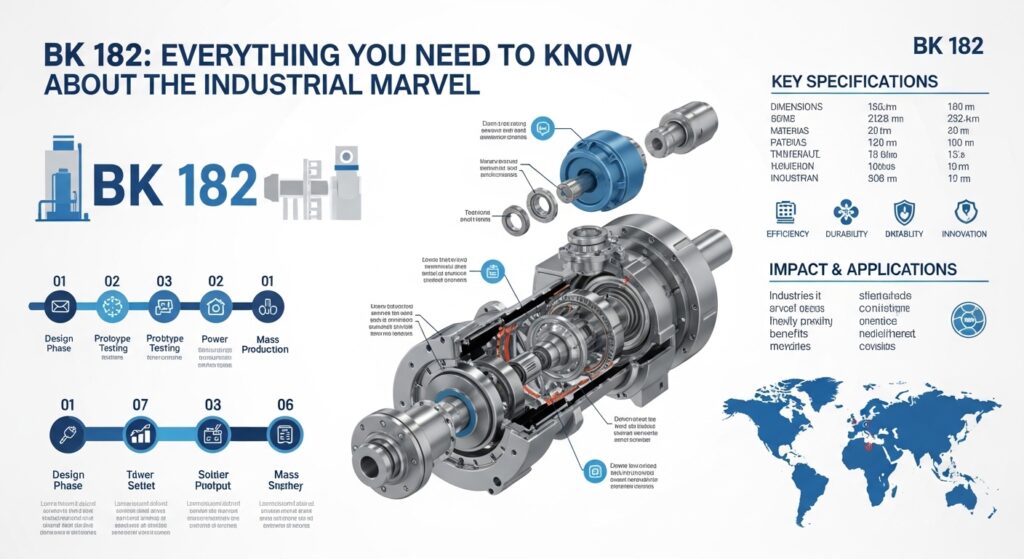
In today’s fast-paced industrial and technological world, specific tools and machinery have become indispensable for efficient operations. One such device is the BK 182, a model renowned for its precision, reliability, and versatility. Although its exact function may vary depending on the industry, BK 182 has consistently proven itself as an essential component in manufacturing, engineering, and commercial applications.
The importance of BK-182 lies not only in its performance but also in how it integrates into workflows, enhancing productivity, reducing errors, and ensuring long-term durability. For companies and professionals looking to optimize processes, understanding BK 182 is a crucial step toward smarter operations.
What is BK 182?
BK-182 is a model of industrial equipment designed for high-precision applications. Depending on the industry, it may be used for manufacturing, mechanical processing, electronics, or even commercial operational support.
Key characteristics of BK-182 include:
-
Precision: Engineered to deliver accurate results in all operations.
-
Reliability: Built to maintain consistent performance over long periods.
-
Versatility: Suitable for multiple functions and applications.
-
Integration: Designed to seamlessly work within larger systems or workflows.
The device is widely adopted in sectors that demand high-quality output, efficiency, and durability, making it a trusted choice among professionals.
| Feature | Description | Benefit |
|---|---|---|
| High Precision | Engineered for exact results | Minimizes errors |
| Reliability | Consistent operation | Reduces downtime |
| Versatility | Multiple applications | Cost-effective |
| Integration | Works with other systems | Streamlined workflows |
Applications of BK 182
BK 182 finds applications across multiple industries due to its adaptability and performance:
Industrial Manufacturing
In factories, BK 182 is used for assembly, machining, and quality control processes. Its precision ensures products meet strict specifications.
Engineering Systems
Engineers rely on BK 182 for processes that require high accuracy, such as automated systems, mechanical operations, and component testing.
Electronics and Technology
Certain models of BK-182 are specialized for electronic processing, monitoring, and calibration tasks.
Commercial Operations
BK-182 assists in tasks like packaging, sorting, and automated handling, improving efficiency and reducing manual labor.
| Industry | Application | Outcome |
|---|---|---|
| Manufacturing | Assembly, machining | High-quality products |
| Engineering | Component automation | Precise operations |
| Electronics | Signal monitoring | Accuracy and reliability |
| Commercial | Sorting, packaging | Faster workflows |
Key Features of BK 182
Several features make BK 182 a standout model in its category:
-
Precision Engineering: Guarantees accuracy and consistency in tasks.
-
Durability: High-quality materials ensure long-lasting performance.
-
Versatility: Can be used in multiple operations or industries.
-
Ease of Integration: Compatible with existing machinery and workflows.
| Feature | Purpose | Advantage |
|---|---|---|
| Precision Engineering | Accurate output | Reduced errors |
| Durability | Long-term usage | Low maintenance |
| Versatility | Adaptable to multiple tasks | Flexible operations |
| Integration | Compatible with systems | Streamlined productivity |
Benefits of BK 182
Using BK 182 offers several advantages:
-
Efficiency: Automates processes and reduces manual intervention.
-
Consistency: Ensures reliable results with every operation.
-
Cost Savings: Reduces waste and maintenance costs due to durability.
-
Flexibility: Can serve multiple purposes within a single system.
-
Productivity: Increases output by optimizing workflows.
| Benefit | Impact |
|---|---|
| Efficiency | Faster operations |
| Consistency | High-quality output |
| Cost Savings | Reduced maintenance |
| Flexibility | Multi-purpose use |
| Productivity | Increased production |
Challenges and Considerations
While BK is highly effective, there are a few considerations for potential users:
-
Maintenance: Regular servicing is required to ensure optimal performance.
-
Training: Operators may need guidance to use the equipment effectively.
-
Upfront Cost: The initial investment can be significant depending on the model.
-
Compatibility: Ensuring integration with existing systems is essential.
| Challenge | Description | Mitigation |
|---|---|---|
| Maintenance | Needs regular servicing | Schedule routine checks |
| Training | Requires skilled operators | Provide proper training |
| Upfront Cost | Initial expense | Evaluate ROI |
| Compatibility | System integration | Assess before purchase |
Future of BK 182
The future of BK 182 looks promising as industries increasingly demand precision, automation, and efficiency. Expected developments include:
-
AI and automation integration for smarter operation.
-
Advanced materials for better durability and sustainability.
-
Enhanced versatility to serve multiple industrial applications.
-
Improved user interfaces for easier control and monitoring.
BK 182 will likely continue evolving, remaining a crucial tool in industrial, commercial, and technological applications.
Conclusion
BK is more than just a model number—it represents a reliable, precise, and versatile industrial tool that has proven its value across manufacturing, engineering, electronics, and commercial operations.
Its combination of precision, durability, and adaptability makes it ideal for businesses and professionals seeking efficiency and quality. While considerations like maintenance, training, and upfront costs exist, the benefits far outweigh the challenges.
For industries aiming to optimize operations, reduce errors, and enhance productivity, BK-182 remains a trusted and indispensable choice.